Put the evidence beside the text
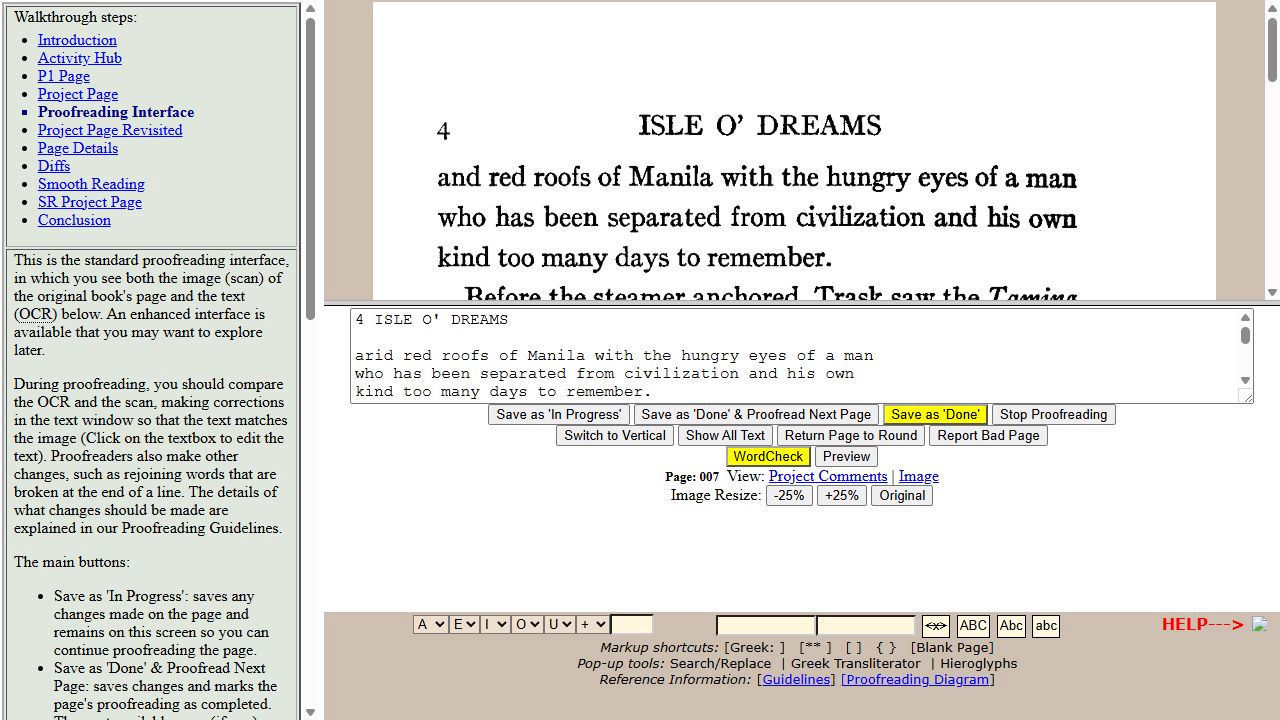
Distributed Proofreaders describes a web-based method for turning U.S.-public-domain books into ebooks by dividing a book into individual pages. Its account of the work is admirably concrete: a volunteer sees a scanned page image beside its OCR text, compares them, corrects the text, and submits it; another volunteer later receives the same image and the earlier work. The scan is not decorative provenance. It is the evidence against which a transcription can be questioned.
Adopt that arrangement even when one editor is working alone. Keep the image and transcription visible together. Begin with the material signals before the sentences: page number, running head, chapter heading, footnote marker, illustration reference, and a line of verse. Then compare word by word at places OCR tends to smooth away—the long dash, apostrophe, small capital, ligature, accented letter, or broken line. Do not correct by intuition when the image can settle the point.
Give uncertainty a place to live
When a scan is blurred, cropped, stained, or ambiguous, mark the exact location and the competing readings. Do not supply a handsome word simply because it makes a paragraph easier. A transcription needs a small uncertainty ledger: image identifier, page or leaf, line or region, proposed reading, alternative, and the reason it remains open. Later, a better scan, a second copy, or a knowledgeable reviewer can answer the question without rediscovering it.
Preserve source spelling and punctuation unless the project declares a documented normalization policy. A reader may need an accessible contemporary edition; a scholar may need a diplomatic transcription; a general reader may need a lightly corrected text. These are different editorial objects. The scan comparison tells us what the witness shows. It does not by itself decide which object should be published.
Use a second pass as a change of attention
Distributed Proofreaders says its books proceed through a second and third proofreading round and two formatting rounds, then may be smooth-read before archive submission. The particular platform sequence belongs to Distributed Proofreaders. The broader lesson is practical: repeat the comparison with a new task. One pass can chase characters, another can inspect line and paragraph structure, and a final reading pass can ask whether the assembled text behaves as a book.
For a small project, appoint a second reader to compare only marked changes and uncertain regions against the scan. For a larger one, divide passes by pages and retain the page-level record. Check that an endnote marker still leads somewhere, that a hyphen is not an OCR line-break scar, and that a running head has not entered the body text. Errors often migrate when pages become chapters.
Keep the witness in the handoff
A delivery folder should retain stable scan links or identifiers, transcription version, unresolved readings, correction log, and any editorial policy for normalization. This does not make the edition infallible. It makes its relationship to the source inspectable, which is a better promise to the next reader and editor.
Sources & limits
No Distributed Proofreaders contribution session or transcription was performed for this entry. The cited walkthrough is a public demonstration: its examples do not save changes and most links are disabled.
- DP: Welcome
Distributed Proofreaders · Source undated · Consulted 16 Sept 2026Distributed Proofreaders describes page-image and OCR comparison, a second volunteer review, a third proofreading round, two formatting rounds, post-processing, and optional smooth reading before Project Gutenberg submission.
- Proofreading
Distributed Proofreaders · Source undated · Consulted 16 Sept 2026The public walkthrough shows the original scan above OCR text, describes correcting against the image and rejoining words split at a line ending, and identifies save-progress, save-done, and WordCheck controls; its examples do not save changes.
Send a correction with the passage and supporting source.