The passage
In “Where I Lived, and What I Lived For,” Thoreau writes that he went to the woods to live deliberately. The sentence is often lifted out as advice, but its force in the chapter comes from its placement. Before and after it, the narrator considers houses, land, work, morning, hunger, and the habits that make people feel occupied without being awake.
A maxim made specific
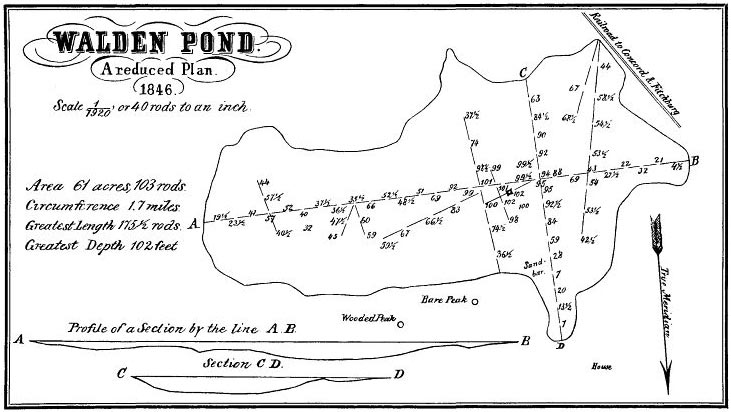
“Deliberately” is not offered as a mood. Thoreau sets it beside verbs of confronting, learning, and stripping life down to essentials. The repetitions give the passage a verbal architecture: live, front, learn, teach, die. Yet the rhetoric remains attached to a body in a particular place. The woods are not a blank backdrop for an idea; they are a chosen scale at which food, shelter, time, and attention can be noticed.
The chapter also qualifies its boldness through performance. Thoreau imagines buying farms he does not buy, measures prospects with comic care, and speaks to readers whose lives he can irritate as easily as instruct. The result is not a program anyone can simply copy. The passage asks what deliberation would mean under its own conditions, then makes the reader aware of the conditions they may be taking for granted. Its sharpest energy lies in that pressure between aphorism and experiment.
A craft use
If you write a line meant to carry beyond its paragraph, give it a local ecology. Let surrounding objects, costs, and contradictions tell the reader what the line requires. An aphorism becomes more durable when the prose has shown its limits as well as its lift. A reader may then carry the sentence elsewhere while remembering that it arose from an experiment, not from an unexamined universal.
Sources & limits
This study reads one chapter in the inspected Gutenberg text and does not offer Walden as universal lifestyle guidance.
- Walden, “Where I Lived, and What I Lived For”
Project Gutenberg · Source undated · Consulted 15 Sept 2026The inspected chapter contains the “live deliberately” passage and its surrounding material reflections. The argument about aphorism and setting is interpretive.
Send a correction with the passage and supporting source.