A federal report proposed a new right against digital replicas
The Copyright Office's first AI report addresses digital replicas, not the copyrightability of AI output.
- Historical event
- July 31, 2024
- First source published
- July 31, 2024
- Site publication
- September 18, 2026
The record
On 31 July 2024, the United States Copyright Office released the first installment of a three-part study titled Copyright and Artificial Intelligence. The Part 1 report states it responds to the Office's own August 2023 Notice of Inquiry, which drew more than ten thousand public comments from authors, performers, technology companies and others across fifty states and sixty-seven countries. Part 1 confines itself to one topic: digital replicas, defined in the report as a video, image or audio recording digitally created or manipulated to realistically but falsely depict an individual. The Office states that later parts would take up the copyrightability of AI-generated output and the training of models on copyrighted works, topics this first report does not decide.
What the documents show
The report's central conclusion is that existing state right-of-publicity laws and other protections leave a gap, and that new federal legislation is needed to address the speed and scale at which AI tools can now produce convincing replicas of a real person's voice or likeness. The Office recommends that any such federal right be licensable but not fully assignable, carry an actual-knowledge standard for platform liability paired with a notice-and-takedown safe harbor, and stop short of preempting existing state laws. The Office's own AI policy hub, retrieved 16 September 2026, confirms the 31 July 2024 release date and situates Part 1 within the wider series, noting that Part 2, on copyrightability, followed in January 2025, and a pre-publication Part 3, on AI training, followed in May 2025. Whether Congress will act on the recommendation is a matter for legislative record, not this report.
Why it stays interesting
Part 1 is useful for what it declines to cover. By separating digital-replica harms from the copyrightability question that dominates most AI-and-books coverage, the Office signaled that a person's voice or image raises a distinct legal interest from a text's authorship. This is an editorial note: for a writer or publisher assessing an AI licensing clause, the report is a reminder that a contract addressing training-data use may say nothing about a narrator's voice or an author's photographed likeness, and that the two questions may eventually be governed by different bodies of law entirely.
What to read next
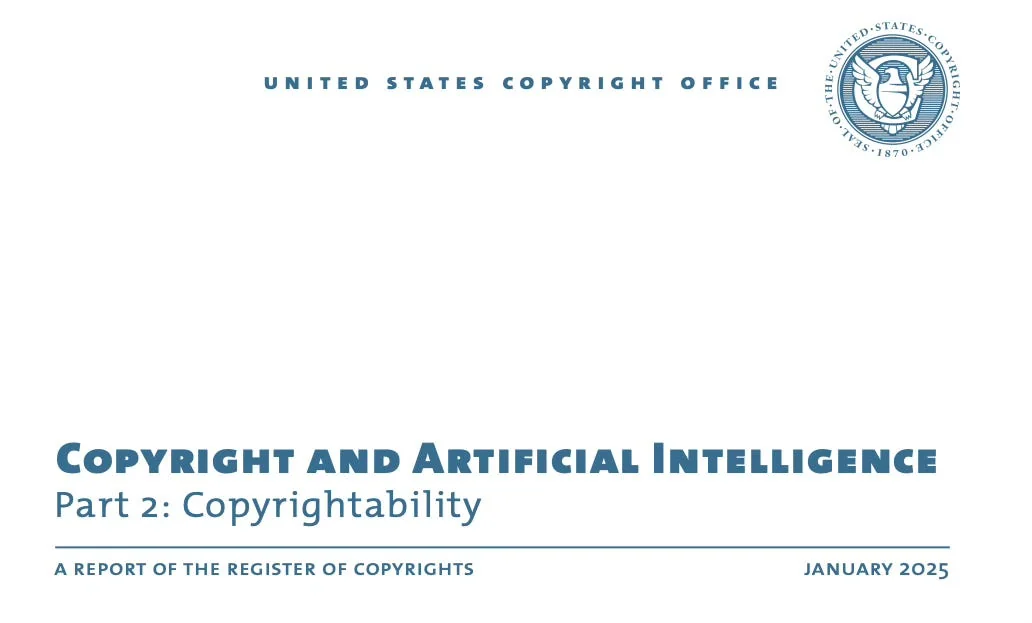
A reader could next check the Office's Part 2 report on copyrightability, which the same policy hub dates to January 2025, to see how the Office reasoned once it turned from replicas to authorship. The Office's original August 2023 Notice of Inquiry, cited within Part 1, would show what questions the ten thousand comments were responding to before this first report took shape.
- Does an AI clause in a publishing or narration contract address training data, a person's voice and likeness, or both?
- Which of the report's recommendations, if any, has Congress since taken up in legislation?
- How would a licensable-but-not-assignable right change what a performer or author could sign away?
A single report cannot settle a fast-moving legal question, and this one does not try to; its narrower achievement is drawing a boundary between two AI harms that public debate often treats as one.
Sources & reading trail
States the report's scope, its origin in the August 2023 Notice of Inquiry, and its recommendation for a new federal digital-replica law.
Source published: 31 July 2024 · Retrieved: 16 September 2026
Confirms the 31 July 2024 release date of Part 1 and situates it within the Office's wider AI report series, as retrieved 16 September 2026.
Source published: Not established · Retrieved: 16 September 2026
Reports, filings, records and studies establish the entry; the reading of why it stays interesting is Chapter Ledger editorial analysis. This retrospective draft does not imply the site published on the event date.
Continue reading
- A comic's text kept copyright while its AI images lost it
- A copyright report left AI authorship a case-by-case question
- Browse the complete the ledger archive
Sources & reading trail
- Copyright and Artificial Intelligence, Part 1: Digital Replicas
Source published: July 31, 2024 · Retrieved: September 16, 2026 - Copyright and Artificial Intelligence (AI policy hub)
Retrieved: September 16, 2026
The documents above establish the record. The reading and the questions are this publication’s editorial analysis, written after the fact.
Published September 18, 2026, not on the date of the event described.