The earliest Mickey Mouse entered the public domain, not the brand
Duke's Public Domain Day 2024 page tracks which 1928 works, including Steamboat Willie, entered the public domain and what trademark still restricts.
- Historical event
- January 1, 2024
- Site publication
- September 18, 2026
The record
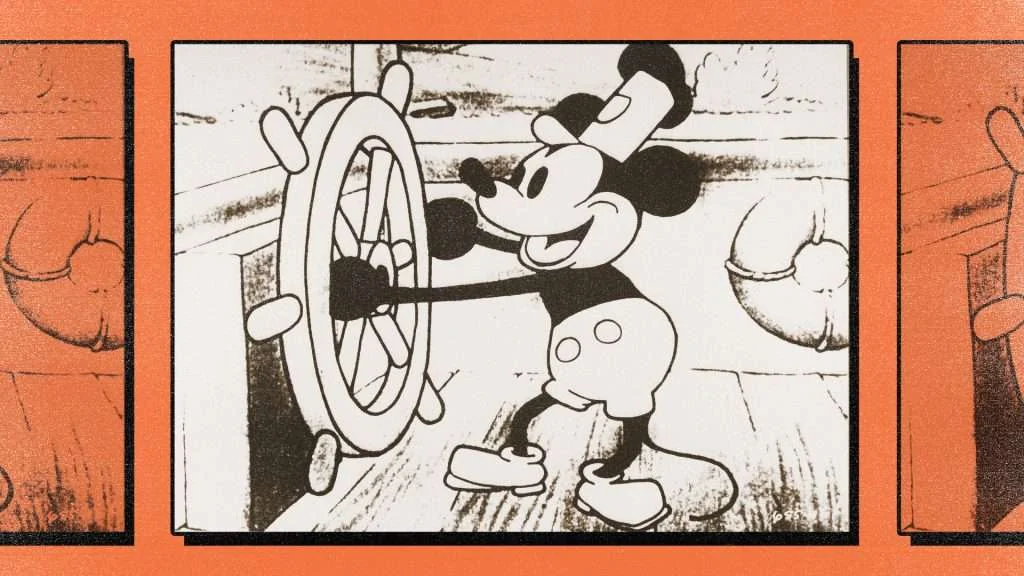
On 1 January 2024, the copyright term expired on works published in the United States in 1928, including Walt Disney's short film Steamboat Willie, the earliest released appearance of Mickey and Minnie Mouse. Duke Law's Center for the Study of the Public Domain documents the full 1928 cohort entering the public domain that day under the 95-year term set for works from that era, listing works such as D.H. Lawrence's Lady Chatterley's Lover, Virginia Woolf's Orlando, A.A. Milne's The House at Pooh Corner, and films by Charlie Chaplin and Buster Keaton alongside the Disney short. The Center published a dedicated companion piece, Mickey, Disney, and the Public Domain: a 95-Year Love Triangle, to address the character specifically, since Mickey Mouse remains a registered trademark even as this one film's copyright has lapsed.
What the documents show
The Center's own account separates two bodies of law that a headline about Mickey entering the public domain tends to blur. Copyright's expiration means the 1928 film itself, and the character as drawn and animated in that specific footage, may now be copied, adapted, and republished. Trademark law is a separate matter: it restricts uses likely to cause confusion about Disney's sponsorship of a product, not uses of the expired film generally. The companion piece also flags what remains protected regardless: Disney continues to hold copyright in later, distinct expressions of the character, such as the white-gloved, red-shorted Mickey from 1940's Fantasia, to the extent each later version adds genuinely new creative expression rather than trivial variation.
Why it stays interesting
The Steamboat Willie case is a compact lesson in how two different bodies of law can apply to the same object without either one fully controlling it. For a reader trying to use a public-domain work responsibly, the Center's distinction between copyright's expiration and trademark's separate, narrower restriction is the practical takeaway: the expiration of one right does not clear every legal question a reuse might raise. This is an editorial note, since the Center itself declines to predict how future disputes over Mickey-adjacent works might be resolved.
What to read next
The Center's 2019 public domain day entry, marking the first US public domain expansion after a twenty-year gap, gives useful background on how the 95-year term came to apply to 1928 works at all. The 1976 Copyright Act's term provisions are the underlying statute this annual expiration depends on.
- Which specific 1928 works have you seen reused since 2024, and did the reuse touch copyright, trademark, or both?
- How would you tell whether a later version of a character has added enough new expression to remain separately protected?
- What other characters might face a similar copyright-trademark split in the coming years?
The record here is Duke's own, dated to the day the term expired, and it is precise about a distinction that a shorter account might have flattened into a single, simpler claim about a mouse.
Sources & reading trail
Lists the 1928 works, including Steamboat Willie, entering the US public domain on 1 January 2024.
Source published: Not established · Retrieved: 16 September 2026
Explains the trademark distinction that continues to restrict use of the Mickey Mouse character despite copyright expiration.
Source published: Not established · Retrieved: 16 September 2026
Reports, filings, records and studies establish the entry; the reading of why it stays interesting is Chapter Ledger editorial analysis. This retrospective draft does not imply the site published on the event date.
Continue reading
- A twenty-year freeze on the public domain calendar finally ended
- A 1976 law moved fair use into the statute for the first time
- A typed Declaration of Independence became the first free ebook
- Browse the complete the ledger archive
Sources & reading trail
- Public Domain Day 2024
Retrieved: September 16, 2026 - Mickey, Disney, and the Public Domain: a 95-Year Love Triangle
Retrieved: September 16, 2026
The documents above establish the record. The reading and the questions are this publication’s editorial analysis, written after the fact.
Published September 18, 2026, not on the date of the event described.