A typed Declaration of Independence became the first free ebook
Project Gutenberg's and Distributed Proofreaders' own pages state how a 1971 typing project grew into a volunteer-run digital library.
- Historical event
- July 4, 1971
- Site publication
- September 18, 2026
The record
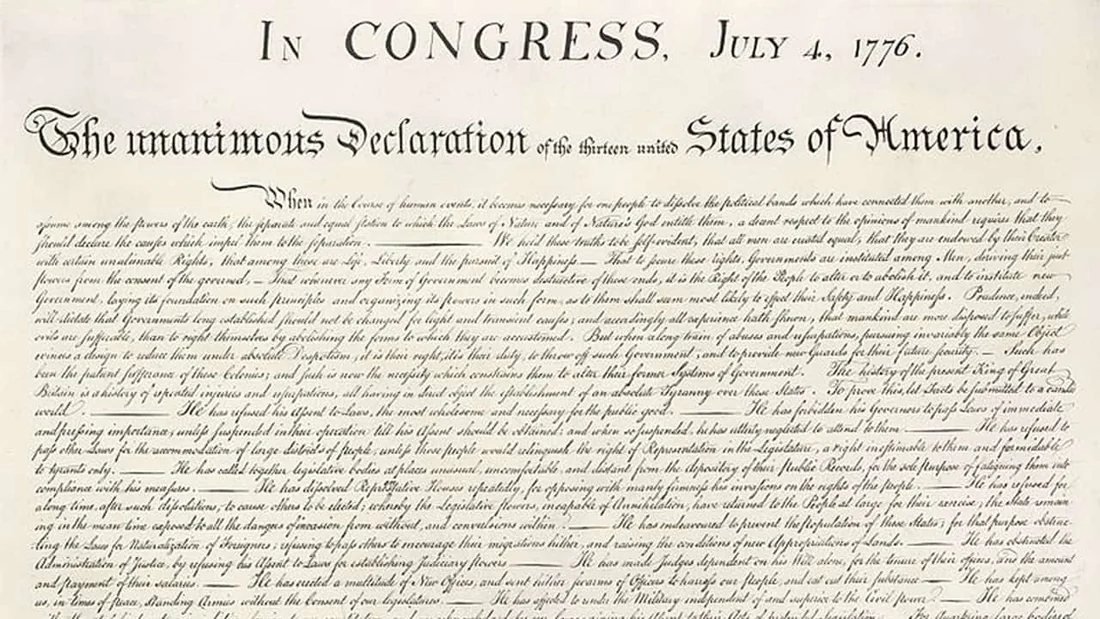
Project Gutenberg's own about page states the claim plainly: "Michael Hart, founder of Project Gutenberg, invented eBooks in 1971." The project's history and philosophy page dates the origin more precisely still, titling its fortieth-anniversary retrospective "Project Gutenberg 4 July 1971 - 4 July 2011," an Independence Day frame that echoes the document Hart is said to have typed first. The project's own fifty-year retrospective describes what Hart envisioned that year as an ebook meant to serve "a similar purpose to the printed book: enjoyable to read," not a scholarly edition or an analytic tool. That retrospective records that "for the two decades from 1971-1991, Hart evangelized the idea of eBooks, and worked on the first 100 or so titles," beginning, in its words, "famously," with the United States Declaration of Independence.
What the documents show
The two Project Gutenberg pages establish the founding claim and its emphasis on reading pleasure over analysis, but both are retrospectives written decades after the fact, not contemporaneous 1971 records. Neither document says how many people could read the shared file at the time, or through what terminal. A separate organisation's own account fills in part of how the project later scaled: the volunteer transcription service Distributed Proofreaders states it "was founded in 2000 by Charles Franks to support the digitization of Public Domain books," became "an official PG site" in 2002, and "a separate legal entity" in 2006, while maintaining "a strong relationship with PG." That record corrects any impression that the project's growth was a solitary act sustained by Hart alone through the following decades; well before Hart's death in 2011, its output depended on an organised volunteer pipeline distinct from its founder.
Why it stays interesting
The founding story is usually retold as a single dramatic gesture: one person, one file, one free book. The sources support that shape for the opening years. But the model changed almost as soon as it needed to scale, from a two-decade run of roughly a hundred titles produced largely by one evangelist to a proofreading infrastructure built and governed by others. This is an editorial observation rather than a claim the sources make directly: for a reader assessing any long-running text project, the useful question is often not who started it, but which decade's workflow produced the specific file in hand.
What to read next
A reader could next check Distributed Proofreaders' own description of how a text is verified before release, a process the 1971 file never passed through. The fifty-year retrospective is also worth reading for its account of the project's later expansion into audio, image, and non-English editions.
- Which edition of a given text was verified under the Distributed Proofreaders workflow, and which predates it?
- What does the project's own account leave unstated about the file's earliest 1971 readers?
- How does a volunteer-verified public-domain text differ from a raw scanned facsimile for a reader's purposes?
Project Gutenberg's founding is well documented in outline and thinly documented in day-to-day detail: an organisation built to preserve exact texts kept a looser account of its own first day.
Sources & reading trail
States Michael Hart founded Project Gutenberg and invented eBooks in 1971.
Source published: Not established · Retrieved: 16 September 2026
Project Gutenberg's own fortieth-anniversary materials title its retrospective '4 July 1971 - 4 July 2011,' dating the founding to Independence Day.
Source published: Not established · Retrieved: 16 September 2026
States Hart's 1971 vision was eBooks for reading enjoyment and that he worked on the first roughly 100 titles from 1971 to 1991, beginning with the US Declaration of Independence.
Source published: 1 January 2021 · Retrieved: 16 September 2026
States Distributed Proofreaders was founded in 2000 by Charles Franks, became an official Project Gutenberg site in 2002, and a separate legal entity in 2006.
Source published: Not established · Retrieved: 16 September 2026
Reports, filings, records and studies establish the entry; the reading of why it stays interesting is Chapter Ledger editorial analysis. This retrospective draft does not imply the site published on the event date.
Continue reading
- A twenty-year freeze on the public domain calendar finally ended
- Research libraries pooled their scans into one shared repository
- A nonprofit set out to build one web page for every book
- Browse the complete the ledger archive
Sources & reading trail
- Welcome to Project Gutenberg
Retrieved: September 16, 2026 - Background, History and Philosophy
Retrieved: September 16, 2026 - 50 years of eBooks: 1971-2021
Source published: January 1, 2021 · Retrieved: September 16, 2026 - About Distributed Proofreaders
Retrieved: September 16, 2026
The documents above establish the record. The reading and the questions are this publication’s editorial analysis, written after the fact.
Published September 18, 2026, not on the date of the event described.