Maryland's library ebook law fell to a federal preemption ruling
A federal court found Maryland's library ebook licensing mandate preempted by the Copyright Act before it ever took effect.
- Historical event
- June 13, 2022
- First source published
- February 16, 2022
- Site publication
- September 18, 2026
The record
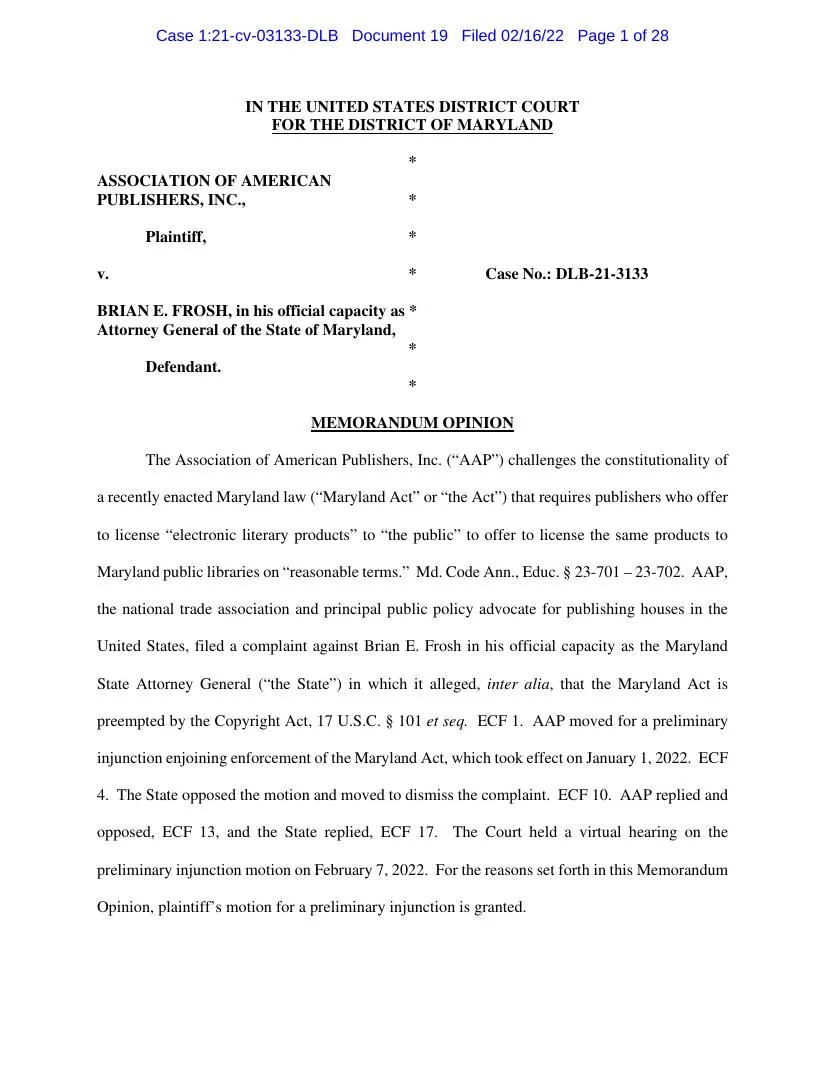
Maryland's legislature passed a law requiring any publisher that licenses ebooks to Maryland consumers to also offer a library license on reasonable terms, set to take effect 1 January 2022. The Association of American Publishers sued the state's attorney general days before that date, and on 16 February 2022 Judge Deborah L. Boardman of the U.S. District Court for the District of Maryland granted a preliminary injunction, finding the Act likely conflicted with the exclusive distribution rights Congress granted copyright holders under Section 106. The court then converted that finding into a final ruling: on 13 June 2022, in a second memorandum opinion, it granted a declaratory judgment that the Act was preempted by the Copyright Act, concluding a declaratory judgment alone was sufficient relief since the Act had never taken effect.
What the documents show
The court's own language is specific: the Act, it held, stands as an obstacle to the accomplishment and execution of the full purposes and objectives of Congress, the standard for conflict preemption under the Supremacy Clause. The February opinion focused on the state's interference with a copyright holder's right to decide whether and to whom to distribute a work; the June opinion resolved the remaining claims, dismissing the publishers' express-preemption count as moot and letting two constitutional claims fall away by stipulation. The AAP's own statement, filed as the case proceeded, frames the law as creating confusion in a vibrant digital economy rather than addressing the library-access problem it was written to solve, the publishers' characterization, not an independent finding beyond the preemption ruling itself.
Why it stays interesting
The ruling is a clean illustration of how a state's interest in library access runs into a federal statute occupying the same ground. For a reader following library ebook policy, the useful distinction is between preemption, a question about which government has authority to legislate at all, and the underlying policy question of whether libraries get reasonable ebook licensing terms, which the ruling does not resolve one way or the other. This is an editorial note: the decision forecloses one legislative route to that goal without commenting on any other.
What to read next
New York's own library ebook bill, vetoed on the same preemption theory before Maryland's case was decided, shows the argument reaching a governor's desk rather than a court. Macmillan's 2019 library ebook embargo is useful background on the licensing terms libraries were already contesting before either legislature acted.
- Which of the court's two opinions, February's injunction or June's declaratory judgment, would a similar state law need to distinguish itself from?
- Does the ruling leave room for a differently drafted state library-access law, or does its reasoning foreclose the approach generally?
- What would reasonable terms have meant in practice had the Act taken effect?
Both opinions come from the same docket and the same judge, and read together they show a single legal theory tested twice, first on a likelihood-of-success standard and then, months later, as a final judgment.
Sources & reading trail
The February 2022 preliminary injunction finding Maryland's Act likely preempted by the Copyright Act.
Source published: 16 February 2022 · Retrieved: 16 September 2026
The June 2022 declaratory judgment finally declaring the Act preempted and disposing of the remaining claims.
Source published: 13 June 2022 · Retrieved: 16 September 2026
AAP's own characterization of the lawsuit and its preemption argument as the case proceeded.
Source published: 15 January 2022 · Retrieved: 16 September 2026
Reports, filings, records and studies establish the entry; the reading of why it stays interesting is Chapter Ledger editorial analysis. This retrospective draft does not imply the site published on the event date.
Continue reading
- New York's governor vetoed a library ebook bill over preemption
- A library ebook embargo lasted less than a year
- A 1976 law moved fair use into the statute for the first time
- Browse the complete the ledger archive
Sources & reading trail
- Memorandum Opinion, Association of American Publishers, Inc. v. Frosh, No. 1:21-cv-03133 (D. Md.)
Source published: February 16, 2022 · Retrieved: September 16, 2026 - Memorandum Opinion and Order and Judgment, Association of American Publishers, Inc. v. Frosh, No. 1:21-cv-03133 (D. Md.)
Source published: June 13, 2022 · Retrieved: September 16, 2026 - AAP Statement Regarding Maryland's Defense of Unconstitutional Shadow Copyright Act
Source published: January 15, 2022 · Retrieved: September 16, 2026
The documents above establish the record. The reading and the questions are this publication’s editorial analysis, written after the fact.
Published September 18, 2026, not on the date of the event described.