A mountain campus conference paired private critique with public talks
Middlebury's own pages date Bread Loaf to 1926 and describe a model of small workshops alongside public lectures.
- Historical event
- January 1, 1926
- Site publication
- September 18, 2026
The record
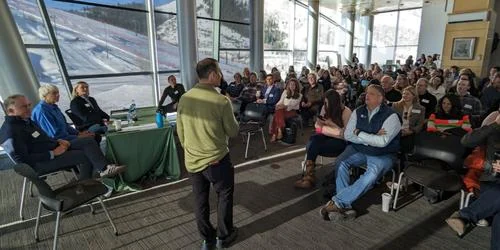
Middlebury College's own page for its writers' conferences states that the Bread Loaf Writers' Conference, founded in 1926, is one of the oldest programs of its kind in the country, and describes what it calls the Bread Loaf model: small-group workshops scheduled alongside public readings and lectures. The college's centennial page, published to mark one hundred years of the conference in 2026, adds that the program's faculty across its first two decades included Willa Cather, Robert Frost, Eudora Welty, Truman Capote, and William Carlos Williams, publishing a fuller list of a hundred writers associated with the conference over its history.
What the documents show
Both pages agree on the founding year and on the conference's basic format, pairing workshop critique with public craft lectures rather than leaving writers to work in isolation. What neither page states is who specifically proposed the conference in 1926 or how its first summer session was organized; the centennial page's own framing, built around a hundred-writer roster spanning a century, is itself a retrospective document assembled for the anniversary rather than a contemporaneous record of the founding meeting. A researcher wanting the founding committee's own account, rather than the college's later summary of it, would need to consult Middlebury's archives directly.
Why it stays interesting
A conference that pairs a small workshop with a public lecture series is making an implicit argument about how craft is learned: partly through close, private critique of a manuscript in progress, and partly through hearing an established writer describe method in front of an audience. That combination, sustained for a century by the college's own account, predates and arguably shaped the workshop-plus-lecture format that later university programs adopted. This is an editorial reading of the format rather than a claim Middlebury makes explicitly, but it is worth noticing when a writing program borrows the shape without the century of practice behind it.
What to read next
A reader could compare Bread Loaf's founding format against a later, differently structured program in this same batch, such as the Clarion workshop's move away from academic faculty toward working authors as instructors, to see two different answers to the same underlying question about who should teach craft.
- Does a given writing program pair private critique with public instruction, or offer only one?
- Who selects the faculty, and by what standard of accomplishment?
- What does a program's own centennial materials include, and what do they leave for the archives to answer?
A hundred years of continuous operation is itself a kind of evidence, though not proof of any particular teaching method's superiority; it confirms only that Middlebury's format found enough writers willing to return to a mountain campus each summer to keep the conference running.
Sources & reading trail
States the 1926 founding year and describes the Bread Loaf model of small-group workshops alongside readings and lectures.
Source published: Not established · Retrieved: 16 September 2026
Marks the conference's 2026 centennial and lists early faculty including Willa Cather, Robert Frost, and Eudora Welty.
Source published: Not established · Retrieved: 16 September 2026
Reports, filings, records and studies establish the entry; the reading of why it stays interesting is Chapter Ledger editorial analysis. This retrospective draft does not imply the site published on the event date.
Continue reading
- A speculative-fiction workshop kept its format through two moves
- The University of Iowa formalised a degree program in 1936
- Fifteen writers founded a home for campus writing programs
- Browse the complete the ledger archive
Sources & reading trail
- Middlebury Bread Loaf Writers' Conferences
Retrieved: September 16, 2026 - Celebrate 100 years of Bread Loaf (Centennial page)
Retrieved: September 16, 2026
The documents above establish the record. The reading and the questions are this publication’s editorial analysis, written after the fact.
Published September 18, 2026, not on the date of the event described.