A digital edition reunited Austen's manuscripts, minus her six novels
The project's own pages name the surviving manuscripts and the one exception among her published novels' drafts.
- Historical event
- October 1, 2010
- Site publication
- September 18, 2026
The record
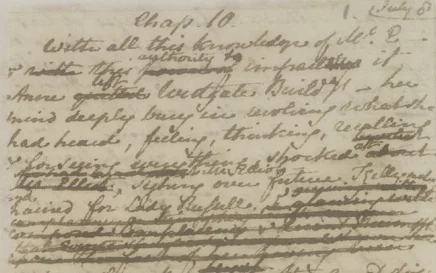
Between early and late October 2010, a research project's homepage changed from describing an intention to describing a finished resource. An early-October snapshot sets out only the project's funding and aims. By 28 October the same page announces that "Jane Austen's Fiction Manuscripts Digital Edition gathers together in the virtual space of the web some 1100 pages of fiction written in Jane Austen's own hand," material "scattered around the world in libraries and private collections." The project's overview page states these manuscripts are "the first significant body of holograph evidence surviving for any British novelist." A three-year Arts and Humanities Research Council grant funded the work, a joint project of Oxford and King's College London under director Kathryn Sutherland.
What the documents show
The edition's own introduction states a fact easy to miss: "no manuscripts appear to remain" for the six published novels as printed. The one exception recorded is "the two cancelled chapters of Persuasion," an alternative ending Austen replaced before publication. What survives instead is earlier and later material: the teenage notebooks Volume the First, Second, and Third, the fair-copy Lady Susan, and the drafts The Watsons and Sanditon, unfinished at her death in 1817. The overview page adds a provenance detail: the papers stayed together until Cassandra Austen's death in 1845, when family dispersal began, with a "second major dispersal" in the 1920s, why the pages now sit across the Bodleian Library, the British Library, the Morgan Library, King's College Cambridge, and Queen Mary University of London.
Why it stays interesting
An edition built from what a writer discarded, not what she published, inverts the usual relationship between archive and print. Because none of the six novels' working manuscripts survive, the collection cannot show how Austen revised toward Pride and Prejudice or Emma; it shows only her practice at points those famous books do not document. This is an editorial note: seeing Austen "at work" in manuscript here means seeing only her earliest and latest efforts, a gap the introduction states plainly, and a caution against assuming any digital archive is complete simply because it exists.
What to read next
The edition's head notes to The Watsons record a change in that manuscript's ownership, updated as recently as 31 July 2012, a reminder that even a "finished" digital edition keeps its own documented history. A reader could compare this with the Emily Dickinson Archive, built from eight lending institutions, or the Mark Twain Papers, where one library eventually held nearly all of one author's manuscripts.
- Does a claim about "Austen's revisions" rely on manuscript evidence, or only on differences between early printed editions of the six novels?
- What does the 1845 and 1920s dispersal change about how a scholar must cite a specific manuscript page today?
- If working drafts of her published novels do not survive, what evidence could responsibly support a claim about how she revised them?
The project's own distinction between what happened to survive and what was actually written is worth keeping in view: an archive this rich can still be a record of survival as much as of authorship.
Sources & reading trail
States the edition now gathers about 1100 pages of manuscript fiction from scattered holders.
Source published: Not established · Retrieved: 16 September 2026
Shows the site describing only aims and funding before the manuscripts became available.
Source published: Not established · Retrieved: 16 September 2026
Names the holding institutions and the 1845 and 1920s dispersal of the manuscripts.
Source published: Not established · Retrieved: 16 September 2026
States that no manuscripts survive for the six published novels except two cancelled Persuasion chapters.
Source published: Not established · Retrieved: 16 September 2026
Reports, filings, records and studies establish the entry; the reading of why it stays interesting is Chapter Ledger editorial analysis. This retrospective draft does not imply the site published on the event date.
Continue reading
- An archive put Dickinson's manuscripts beside her printed editions
- A trust delayed Mark Twain's papers reaching a public archive
- Browse the complete the ledger archive
Sources & reading trail
- Jane Austen's Fiction Manuscripts (post-launch homepage)
Retrieved: September 16, 2026 - Jane Austen's Fiction Manuscripts (pre-launch homepage)
Retrieved: September 16, 2026 - About the Project: Overview
Retrieved: September 16, 2026 - Introduction to the Edition
Retrieved: September 16, 2026
The documents above establish the record. The reading and the questions are this publication’s editorial analysis, written after the fact.
Published September 18, 2026, not on the date of the event described.