A wartime council printed over 122 million paperbacks for troops
A Library of Congress research guide dates the 1943-1947 program, its 1,324 titles, and states the format it extended rather than invented.
- Historical event
- January 1, 1943
- Site publication
- September 18, 2026
The record
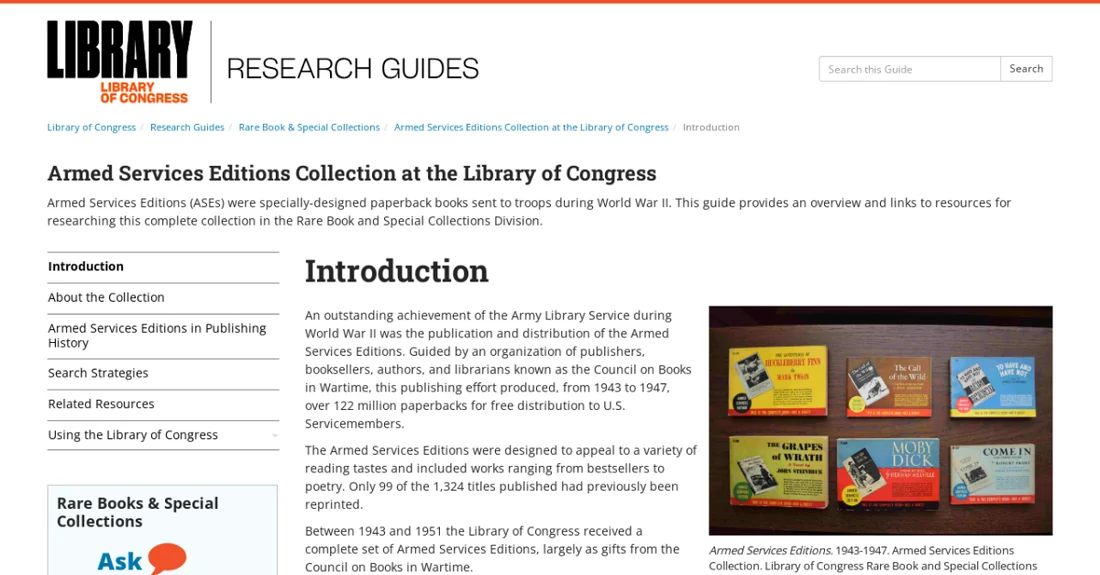
A wartime publishing program built on a format that already existed became, by scale alone, a different kind of event. The Library of Congress's own research guide to its Armed Services Editions Collection states that the program was 'guided by an organization of publishers, booksellers, authors, and librarians known as the Council on Books in Wartime,' which 'produced, from 1943 to 1947, over 122 million paperbacks for free distribution to U.S. Servicemembers.' The guide states that 'only 99 of the 1,324 titles published had previously been reprinted,' and that between 1943 and 1951 the Library itself received a complete set, 'largely as gifts from the Council on Books in Wartime.'
What the documents show
The same guide's publishing-history page is careful about what the program did and did not originate: 'ASEs were not the first paperbacks,' it states, noting that 'Allen Lane introduced the popular Penguin paperbacks in England in the 1930s and Pocket Books in the United States appeared shortly after.' What the program added, the same page states, is that it 'certainly contributed to a new era in publishing in the 1940s and 50s' — a claim about publishing's direction rather than a claim of invention, and this record follows that distinction rather than crediting the program with starting the paperback format itself.
Why it stays interesting
A print run of over 122 million copies, distributed free rather than sold, is a different kind of market event than a commercial launch: it did not have to persuade a single buyer, only reach a captive and mobile readership. That distinction matters for anyone tempted to read the program as proof that cheap paperbacks alone create demand; the Library's own account credits the wartime distribution with habituating readers to the format, not with inventing the appetite for it. This is an editorial point worth carrying into any claim about a format 'creating' a market.
What to read next
The entry on Penguin Books names the format this program built on directly; the entry on the Book-of-the-Month Club offers a contemporaneous, commercial mechanism for reaching readers that the wartime program did not need to replicate.
- Does a claim about a format 'creating' postwar demand distinguish habituation from origination, as the Library's own account does?
- What does free, captive distribution measure that a commercial sales figure cannot?
- Of 1,324 titles, only 99 had been reprinted before — what does that ratio suggest about the program's editorial ambitions beyond simple reissue?
The scale of the program, not its originality, is what the Library's own guide documents most firmly, and that distinction is the more useful one to carry forward.
Sources & reading trail
States the Council on Books in Wartime's role, the 1943-1947 dates, the over-122-million print run, and the 1,324 titles published.
Source published: Not established · Retrieved: 16 September 2026
States that Armed Services Editions were not the first paperbacks, naming Penguin and Pocket Books as precedents.
Source published: Not established · Retrieved: 16 September 2026
Reports, filings, records and studies establish the entry; the reading of why it stays interesting is Chapter Ledger editorial analysis. This retrospective draft does not imply the site published on the event date.
Continue reading
- A 1934 train delay led to a sixpenny paperback the next year
- A 1926 book club's own centennial page meets its rejection file
- A writers' club founded fellowship and advocacy together
- Browse the complete the ledger archive
Sources & reading trail
- Armed Services Editions Collection at the Library of Congress: Introduction
Retrieved: September 16, 2026 - Armed Services Editions Collection at the Library of Congress: Publishing History
Retrieved: September 16, 2026
The documents above establish the record. The reading and the questions are this publication’s editorial analysis, written after the fact.
Published September 18, 2026, not on the date of the event described.